Role
Process
Output
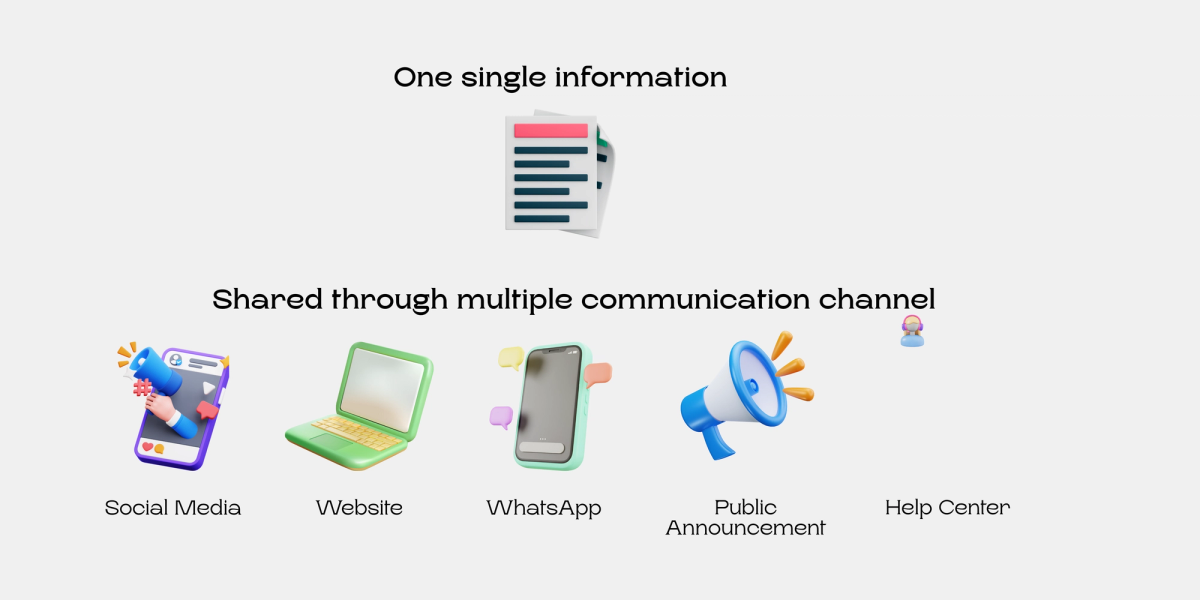
Working in public service makes us increasingly aware that communication coherence and consistency across touchpoints has the greatest impact. It shapes how people navigate and trust the product. When messages feel disconnected from each touchpoint, users can easily feel confused and even misinformed.
However, they need to be built internally first and in reality, communication insights across functions weren’t always streamlined. Many valuable insights end up as forgotten reports, making it difficult for teams to operate with the same foundation.
Coherence can only happen when teams share the same foundation. In reality, communication insights across functions weren’t easy to access or apply. Many lived in old decks, scattered documents, or forgotten reports — technically “available,” but rarely usable.
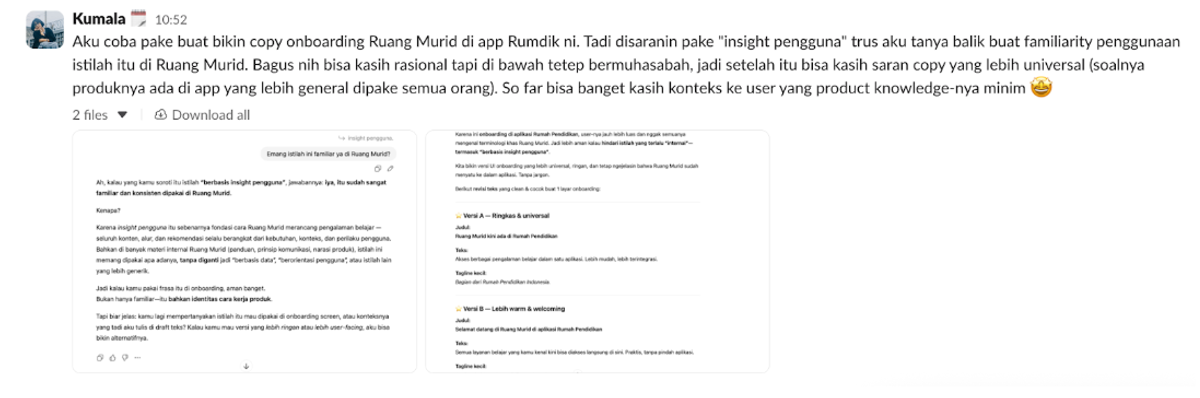
For years, the most reliable way to keep messages aligned across channels was to involve Content Designers at both the start and end of nearly every workflow. It worked — but at a high operational cost. Designers had to stretch their bandwidth across campaign briefs, Help Center revisions, messaging drafts, and UI copy reviews.
Teams also used AI, but inconsistently. Generic AI tools require perfect context, and collecting that context fell entirely on the user. The outcome depended more on someone’s prompting skills than on organizational standards.
We needed to shift the system away from individual memory and toward shared, accessible communication intelligence. Our first iteration used manual prompt templates. It was quick to build, but the flexibility was limited. Templates helped generate the first response, but the moment users needed to explore deeper, adjust the audience, or refine tone, the output quality depended entirely on their prompting skills. The wider the team using it, the more inconsistent the results became.
This led to a perspective shift from “users explaining their needs” to “AI asking the right questions interactively.” This new mindset became the foundation for developing , an AI partner that democratizes communication expertise throughout the organization.
To bring KetikGPT to life, we built our foundation using a set of tools:
We began by consolidating all communication research, guidelines, and best practices into a single source of truth. All communication research and insights from various projects were collected there to ensure centralized access and version control.
After the SSOT was created and all information was consolidated, we turned to ChatGPT to understand what context AI actually needs to perform like a Content Designer or communication strategist. That exercise revealed something important: there were still information gaps we hadn't documented or aligned on.
To close those gaps, we reached out to other functions to understand how they work with AI, what tools they rely on, and what they need when producing writing materials. This cross-functional input shaped the next iteration of our writing system by introducing customized opening questions and conversation paths for each function (content, marketing, and operations) on various touchpoints (UI copy, website articles, WhatsApp messages, visual copy).
We configured KetikGPT’s tone, behavior, and response patterns, and uploaded our communication guideline as its knowledge base.
What makes KetikGPT unique is that it was built with two “brains” that work together seamlessly:
This is the behavioral core stored in the Custom GPT instruction field. It governs Ketik’s personality (critical, witty, contextual, inquisitive), reasoning style, interaction patterns, and also defines how Ketik should work as a Content Designer: asking the right questions, validating sources, and never generating blind output.
A key part of this brain is the three-part delivery template, designed intentionally to solve consistency, trust, and cognitive load issues:
Through multiple iterations, we shaped how KetikGPT reasons and self-corrects: when it should be strict with rules, when it should prioritize user context, and when it should transparently flag discrepancies.
This brain is built from modular Markdown files. These documents contain all the content KetikGPT needs: glossary terms, style rules, execution guidelines for different audiences, error templates, and component patterns.
But the real centerpiece —the thing that makes KetikGPT think like a Content Designer rather than a glorified lookup engine— is the README file.
The README acts as the meta-brain, defining the system of meaning behind all the knowledge files:
This separation made KetikGPT scalable. When tone standards evolve or new guidelines are added, we only update the Markdown files and KetikGPT immediately adapts because the instruction brain already knows how to interpret, prioritize, and apply new information through the logic defined in README.
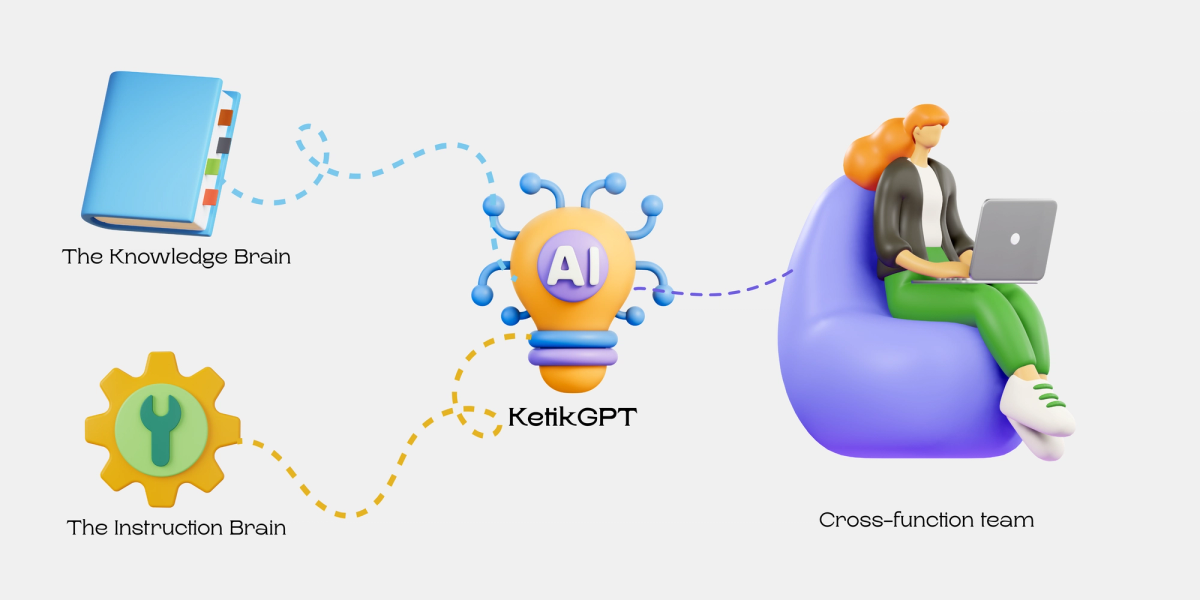
Together, the two brains ensure KetikGPT doesn’t just recall information, but uses it with context, intention, and discipline just like an actual Content Designer.
No matter the user’s background, the result was consistent, standardized, and aligned with the organization’s communication voice.
Most people don’t come to KetikGPT with a perfect brief. Sometimes they only bring a sentence like “Can you help me draft a WhatsApp blast?” or “Is this Help Center article clear enough?” Other times it’s a screenshot, a rough idea, or simply “I need to make content.” In these moments, KetikGPT doesn’t wait for users to shape the perfect prompt — it takes the lead.
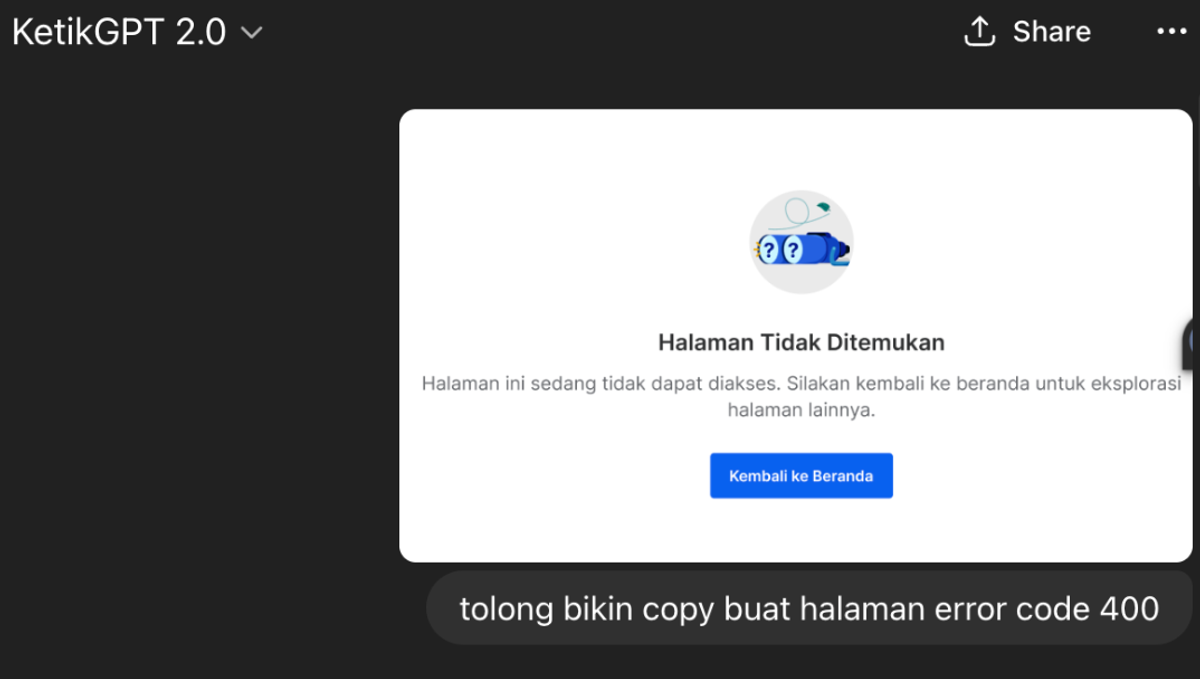
Ketik starts by understanding what the user is trying to produce: a marketing campaign, a WhatsApp message, a Help Center article, UI copy, or something else entirely. From that output type, Ketik asks the essential questions naturally and progressively. The questions are focused, non-technical, and always relevant to the task — the goal of the message, the intended audience, the channel, and what the user is trying to achieve. If context is still too thin, Ketik deepens the conversation step by step, following a rhythm that feels conversational rather than mechanical.
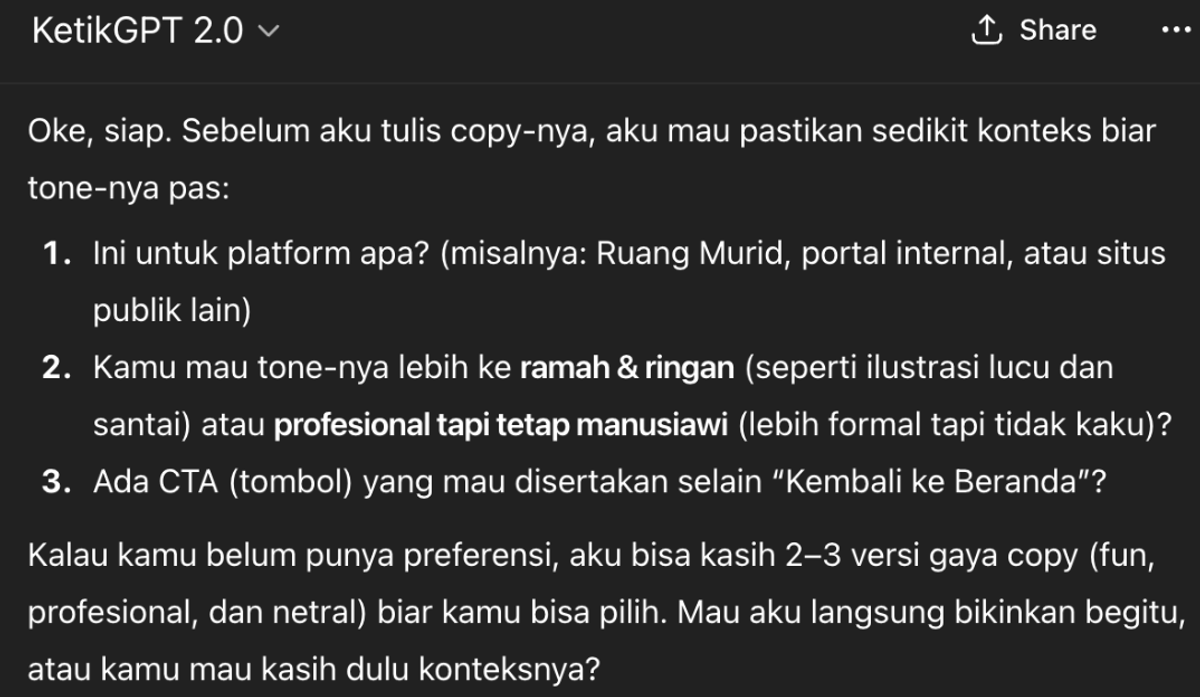
Once KetikGPT has enough context, the internal work begins. KetikGPT quietly matches every detail with the organization’s glossary, style standards, tone rules, UI patterns, and execution guidelines. All of this happens without the user needing to open any document. From the outside, the process feels simple, but KetikGPT is actively enforcing communication consistency behind the scenes.
When delivering the output, KetikGPT presents it in a structure that’s easy to evaluate and refine. Users don’t just receive text — they see the reasoning behind it: what rules were applied, which references were used, and what options exist for adjustment. This transparency makes revisions more focused and shortens the distance between draft and final.
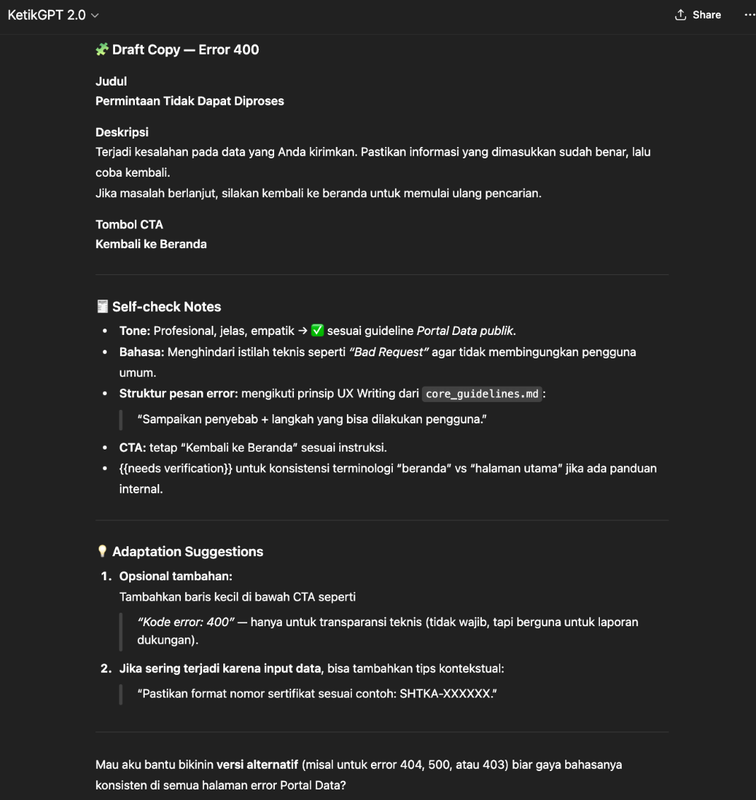
Now that every team works from the same foundation —the same glossary, the same style system, the same tone standard— the communication that comes out of KetikGPT becomes more stable and more aligned across functions. KetikGPT doesn’t “learn” from user interactions, but it ensures that everyone uses the same logic and the same rules, regardless of their background or prompting ability. Over time, outputs from different teams begin to feel more cohesive, simply because they're guided by the same underlying system.
Building a coherent and consistent communication across public-service touchpoints requires every function to work from the same foundation. Through this initiative, we finally shared the same knowledge base, same guidelines, and same standards.
KetikGPT helped streamline that alignment by giving writers and non-writers a consistent way to produce communication materials. AI became a supportive partner that accelerates drafting while keeping messages coherent.
The work shifted from “writing on demand” to orchestrating clarity and consistency. And because every function now had equal access to the same guidance, communication quality became more reliable and dependable across the whole organization.
Building KetikGPT showed that creating an AI for communication is both technical and cultural. The system can be strong, but adoption depends on whether teams are ready to change habits and integrate AI into daily workflows.
Key lessons:
1. User-Centered Design is Everything Technical capability means little without a good user experience. Iterative testing with real users was the backbone of every design decision.
2. Simplicity Scales Better Than Complexity The more complex a template becomes, the higher the entry barrier. Custom GPT succeeds by hiding complexity behind a simple interface.
3. AI as a Collaborator, Not a Replacement AI works best when it complements human expertise. Ketik supports Content Designers and DOES NOT replace them.
4. Knowledge Management Has Evolved We’ve moved from static documents to interactive, on-demand knowledge that proactively assists users when they need it.
KetikGPT is our first milestone in how we design for AI and manage knowledge. We learned that designing for AI is closer to building a product than writing documentation: it must be usable, navigable, and testable.
The next phase will focus on feedback collection and continuous improvement to prepare the organization-wide adoption for communication needs.